
AFRICA MALARIA PROGRESS REPORT 2025
Africa is not on track to achieve its goals of eliminating malaria by 2030
The 2025 Africa Malaria Progress report was released this week with the revelation that the African Union Member States account for most global malaria cases (96%) and deaths (97%) and overall progress remains stalled.
Among the malaria-endemic member states, 11 have achieved the 2020 goal of reducing malaria incidence and mortality by 40 %and 5% are on track to achieve the 2025 target of a 75% reduction.
The report documents the risks of retreat at a moment of constrained financing and intensifying threats.
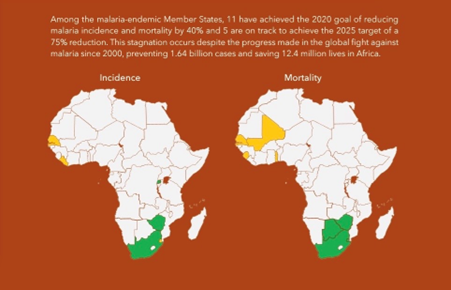
Credit: Malaria Progress Report 2025
Issues at hand:
The report notes that Member States are not on track to achieve targets, which will undermine the goal of malaria elimination by 2030.
According to the World Health Organisation, there are 270.8 million malaria cases which account for 96% of the global total.
The report also records 594, 119 deaths (97% of global total) in AU member states in 2024, noting that progress towards malaria elimination remains stalled since 2015.
What has been done so far?
- So far, 24 countries have introduced World Health Organisation approved malaria vaccines
- Member States are expanding the use of dual active-ingredient Insecticide-Treated Nets (ITNs)
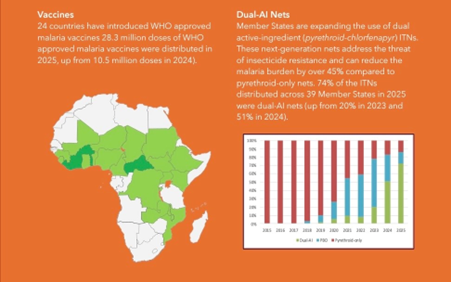
Credit: Malaria Progress Report 2025
While Member States have made progress in deploying a broader malaria toolkit and approaches for combating the disease, the “Perfect Storm “continues to intensify to threatens to set back progress against malaria significantly.
Decline in Official Development Assistance
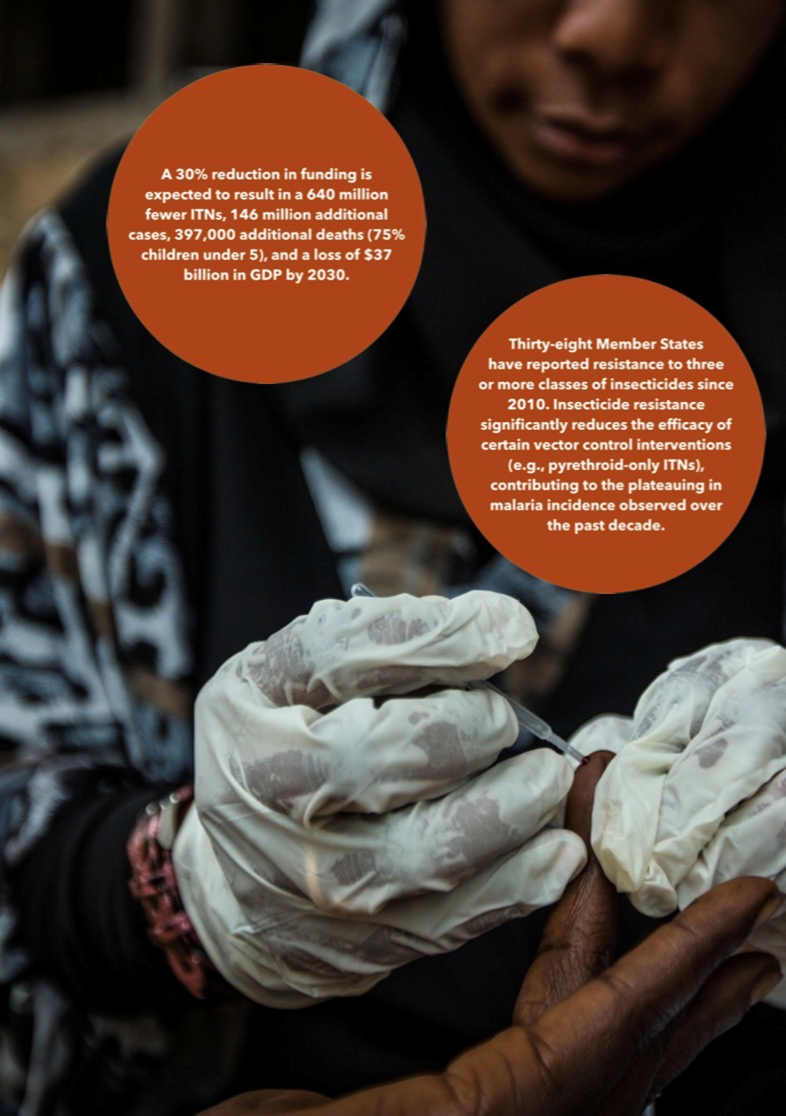
The declining funding and complex fiscal environment are a key factor in this setback. Member States capacity to accelerate progress against malaria was limited by declining funding in 2025.
Official Development Assistance (ODA) declined by 21% in 2025 as several donor countries reduced and redirected bilateral and multilateral support.
The funding environment is expected to remain constrained in the coming years, as funding is cut from key donors.
Climate Change and Extreme Weather events
Changing weather patterns continue to make malaria more unpredictable and difficult to control, especially when coupled with intervention gaps.
Flooding and higher temperatures contribute to malaria upsurges and increased burdens on already strained health systems.
From the release of the report, data indicates that Member States are not on target
Call to action
The report urges all Member States to treat malaria as a central pillar of health sovereignty and economic transformation, to protect and increase domestic and external funding, and to fully implement the priorities of the catalytic framework and the “Big Push” against Malaria.
The report calls for increased funding and greater national leadership as follows:
Priorities of the Big Push Against Malaria
- Advance National leadership, accountability and an integrated malaria response
- Protect funding for malaria and advocate for new resources (including innovative financing)
- Strengthen data systems and enable data -driven decision -making
- Increase accessibility, acceptability and quality of existing interventions
- Develop and prepare for rapid introduction of new fit-for purpose tools
- Improve co-ordination between global, region and country partners for efficient resource use
At the African Union Summit in 2025, Heads of State and Government endorsed the African Union Roadmap to 2030adn Beyond: Sustaining the AIDS Response, Ensuring Systems Strengthening and Health Security for the Development of Africa,
Source: