
Webinar 4: Reporting the Science Right- Covering Emerging Technologies
In the on-going webinar series: Truth Under the Microscope the BioTRUST Institute and African Genetic Biocontrol Consortium (AGBC), in collaboration with the Elizabeth R. Griffin Program at Johns Hopkins University are delighted to bring you
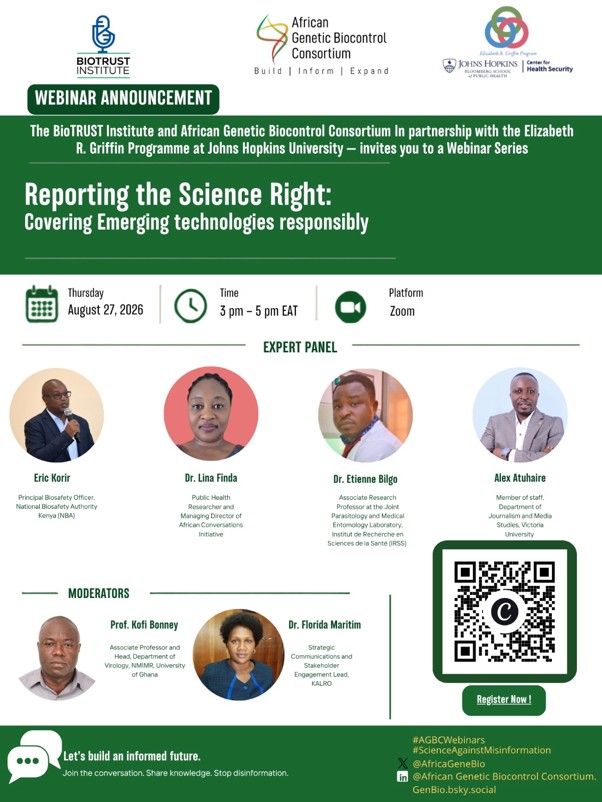
Webinar 4: Reporting the Science Right- Covering Emerging Technologies Responsibly:Thur, Aug, 27
Webinar 4 overview : This two-hour webinar will equip participants with practical tools for identifying credible scientific evidence, interrogating claims about emerging technologies, choosing appropriate expert sources, communicating uncertainty, and explaining risks and benefits in ways that are accurate, inclusive, and useful to the public. The session combines expert reflections, editorial guidance, real-world reporting scenarios, and audience engagement.
Webinar 4 Objectives: The objectives aim to help participants:
- Report on emerging technologies accurately, in context, and in the public interest.
- Distinguish evidence-based science reporting from speculation, promotion, misinformation, and hype.
- Apply ethical reporting principles that address equity, human rights, privacy, safety, inclusion, and unintended consequences.
- Interview scientists, technologists, policymakers, affected communities, and independent experts effectively.
- Explain scientific uncertainty, limitations, risks, benefits, and trade-offs clearly.
- Use digital and AI-assisted tools responsibly while upholding editorial independence, transparency, and verification standards.
The webinar will be held online via Zoom, with French and English interpretation on Thursday, August 27, from 1500 to 1700 hours EAT/ 12 NOON GMT.
Potential Outcomes from webinar 4: By the end of the session, participants should be able to:
- Recognise hype, misinformation and unsupported claims
Participants will be better equipped to distinguish credible, evidence-based science from speculation, marketing, exaggeration, and misinformation. - Ask the right questions about technology and its impact
Participants will know how to interrogate claims about benefits, risks, limitations, unintended consequences, and who stands to gain or lose. - Apply an ethical and public-interest lens
Participants will consider equity, human rights, privacy, safety, inclusion, and potential harm when reporting on emerging technologies. - Interview beyond the usual experts
Participants will understand the value of seeking perspectives from scientists, technologists, policymakers, independent experts, and—critically—communities affected by the technology. - Communicate uncertainty without creating confusion
Participants will learn how to explain what is known, what is not known, how strong the evidence is, and why uncertainty matters. - Use AI and digital tools without compromising journalism
Participants will understand how to use AI-assisted tools responsibly while maintaining verification, transparency, editorial independence, and accountability.