WEBINAR SERIES: TRUTH UNDER THE MICROSCOPE
Tackling disinformation and misinformation in emerging technologies and life sciences.
The BioTRUST Institute and the African Genetic Biocontrol Consortium, in collaboration with the Elizabeth R. Griffin Program at John Hopkins University launched webinar 1 in the series: “Truth under the Microscope.”
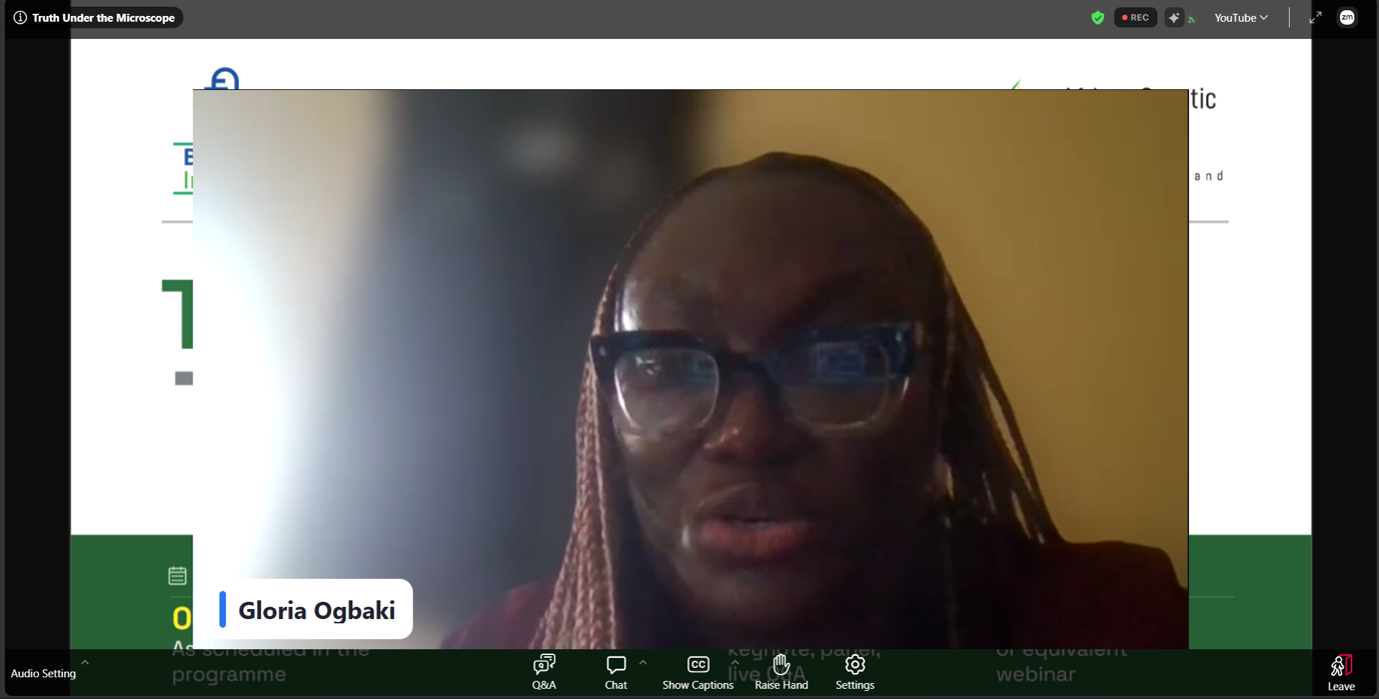
The webinar was co-moderated by Dr. Gloria Ogbaki of the National Biosafety Management Agency (NBMA) in Nigeria and Arouna Ouedraogo of the National Biosafety Agency in Burkina Faso. Gloria is also chair of the Science Communication Forum. They guided discussions and audience engagement, ensuring thematic coherence throughout the session.
The Chief Executive Officer Rosalia Omungo set the tone for the webinar by highlighting the significance of the topic in an information age where news travels fast, and the advent of social media has made the speed even faster. The problem, she noted, lies in the habits of many individuals of readily transmitting information that has not been verified, thus sharing information that may not be accurate. She highlighted the purpose of the webinar series: to explore how misinformation and disinformation arise, understand their impacts on science and policy, share evidence-based communication approaches, strengthen collaboration among stakeholders, and build lasting public trust in responsible scientific innovation.

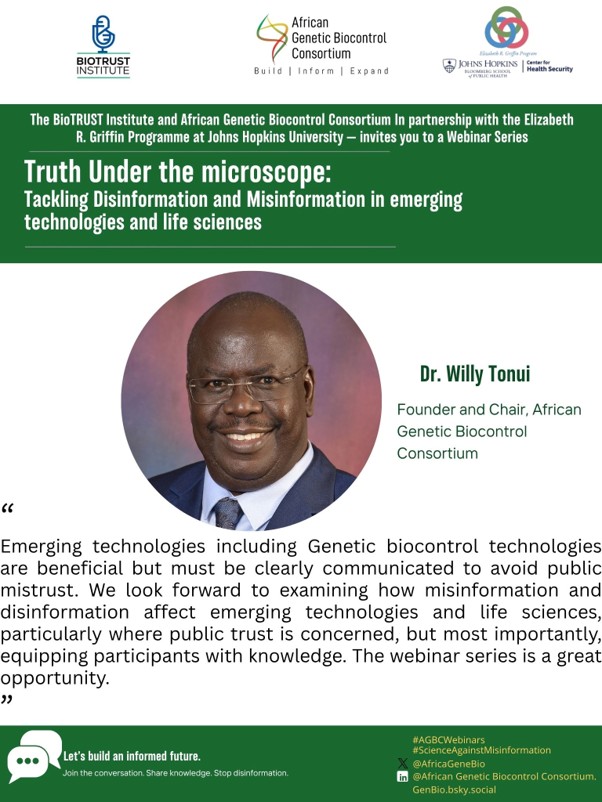
Chairman and Founder of the African Genetic Biocontrol Consortium Dr. Willy Tonui welcomed all participants. He underscored the need for accurate information sharing to promote public trust in emerging technologies.
The partnership between BioTRUST Institute the African Genetic Biocontrol Consortium and the Elizabeth R. Griffin Programme at the Johns Hopkins University could not have come at a better time.
The Director of the Programme Dr. Erin Sorrell, gave a background on how the Institute emerged, noting that it was formed by the family of Elizabeth “Beth” Griffin. Beth Griffin died in 1997 aged 22 after contracting a rare virus from a macaque monkey accidentally while working as a primate researcher. Her family created the non-profit in 1999 to improve biosafety and prevent similar tragedies.
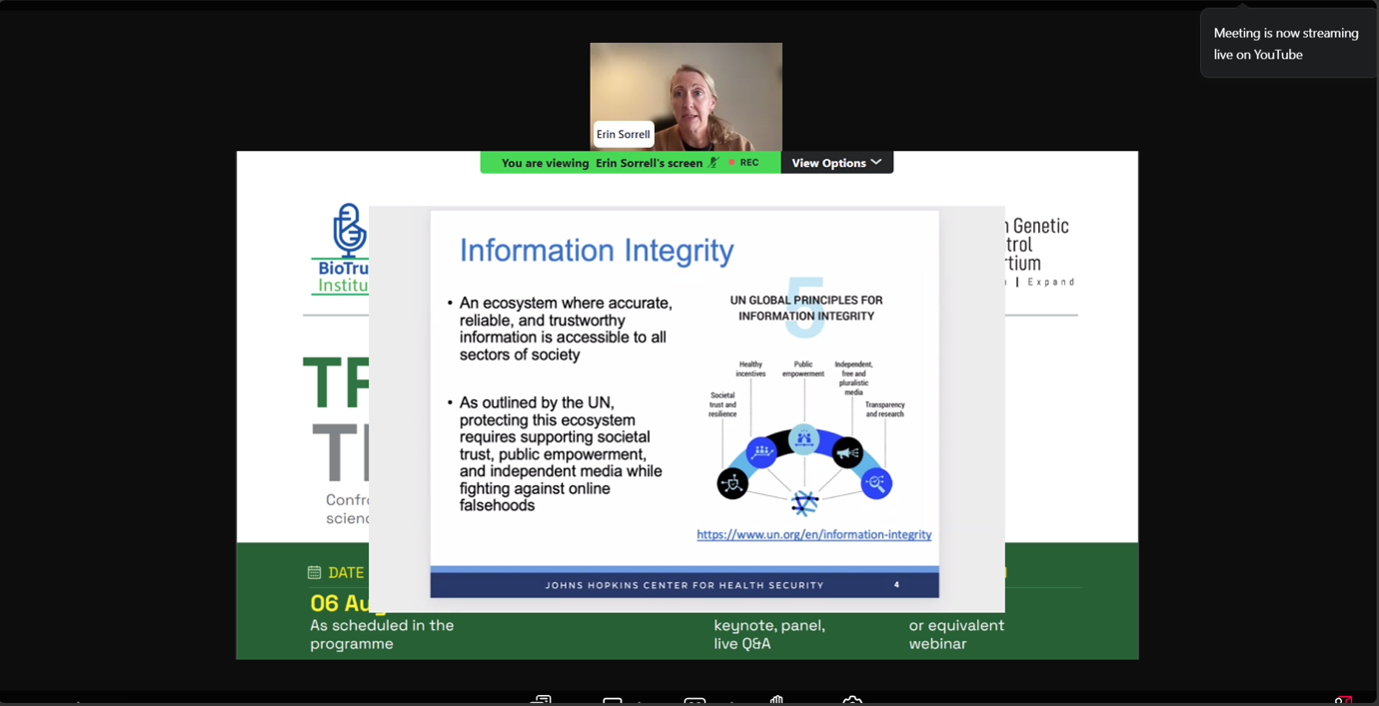
Dr. Sorrell then set the pace through the description of Information Integrity. According to the UN Global Principles for Information Integrity: Information integrity refers to an ecosystem where accurate, reliable and trustworthy information is accessible to all sectors of society.
As outlined by the UN, protecting this ecosystem requires supporting societal trust, public empowerment and independent media while fighting against online falsehoods. Participants were asked to post what information integrity means to them, and words like accuracy and credibility popped up.
Dr. Sorrell drew attention to the risks posed by disinformation, restrictions on press freedom, and the malicious use of technologies. She explained that inaccurate or distorted data in emerging technologies such as artificial intelligence can lead to unsafe, biased, or flawed outcomes. Similarly, in the life sciences, poor information integrity can invalidate research results, obscure safety issues, and delay treatments or approvals. She noted that public trust is quickly eroded when information is misleading or manipulated, slowing the adoption of new technologies. Finally, she cautioned that policymaking is particularly vulnerable: when built on inaccurate data, laws and regulations risk becoming ineffective, outdated.
Dr. Sorrell’s keynote set the tone for the webinar by framing information integrity as a critical pillar for advancing responsible innovation, strengthening public confidence, and ensuring that science and technology serve society effectively.
Dr. Justin Overcash, a Technical Expert in Genetic Biocontrol, Regulation, and Policy with the GeneConvene Global Collaborative at the Foundation for the National Institutes of Health (FNIH), focused on the intersection of artificial intelligence and misinformation. He began by noting that fabricated information is not new; what has changed is the scale, speed, and
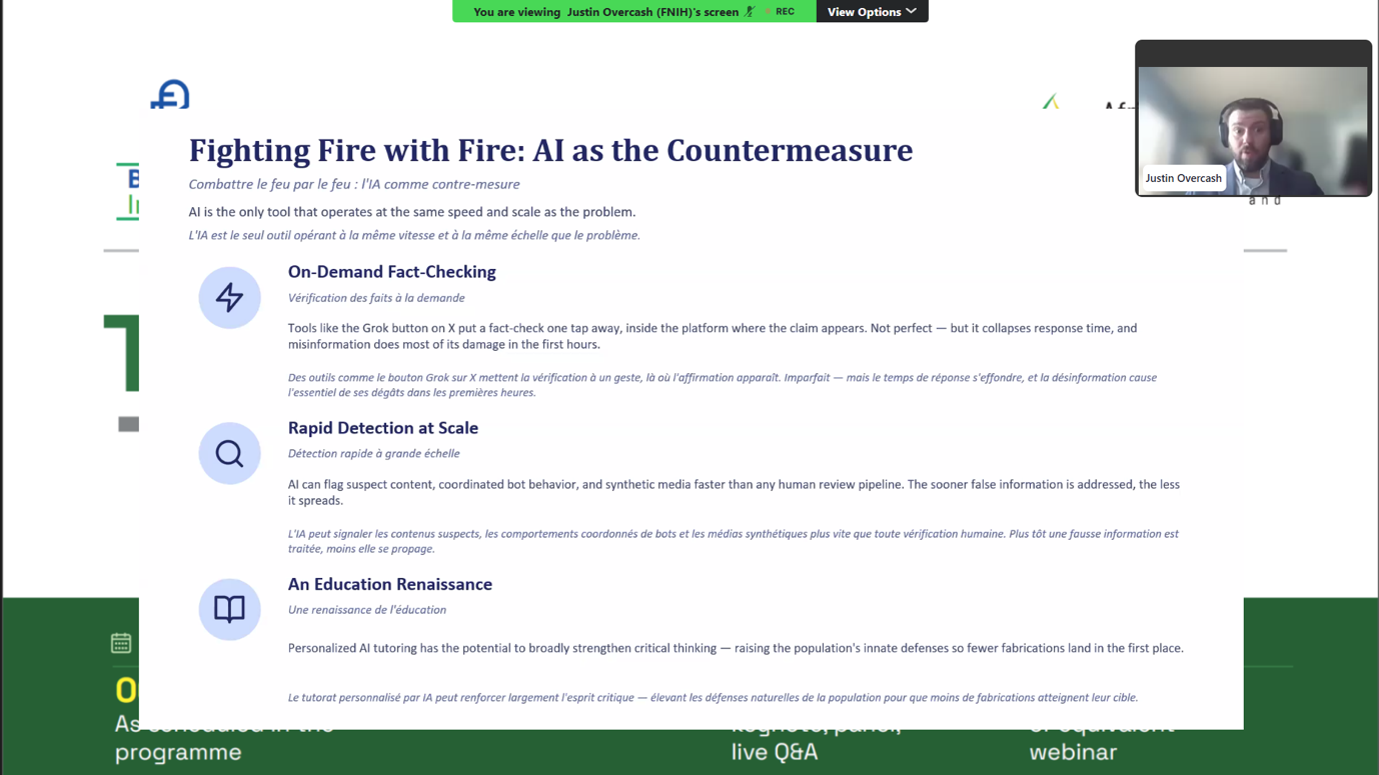
He highlighted several emerging risks, including synthetic video generation converging on short-form content that resonates strongly with younger audiences, AI-written articles embedding plausible but incorrect details at publishing scale, and coordinated bot networks manipulating algorithms to amplify false narratives. He also drew attention to the rise of antagonistic AI agents’ persistent systems capable of adapting, arguing, and building rapport representing one of the least-discussed but fastest-emerging threats.
Looking to the future, he argued that an equilibrium is emerging where credibility and provenance will be rewarded over sheer volume. Verified journalism and human-authored content, he suggested, may gain premium value as synthetic content becomes the default. He also noted that widespread exposure to AI-generated material could foster a healthy skepticism among audiences, making them harder to deceive.
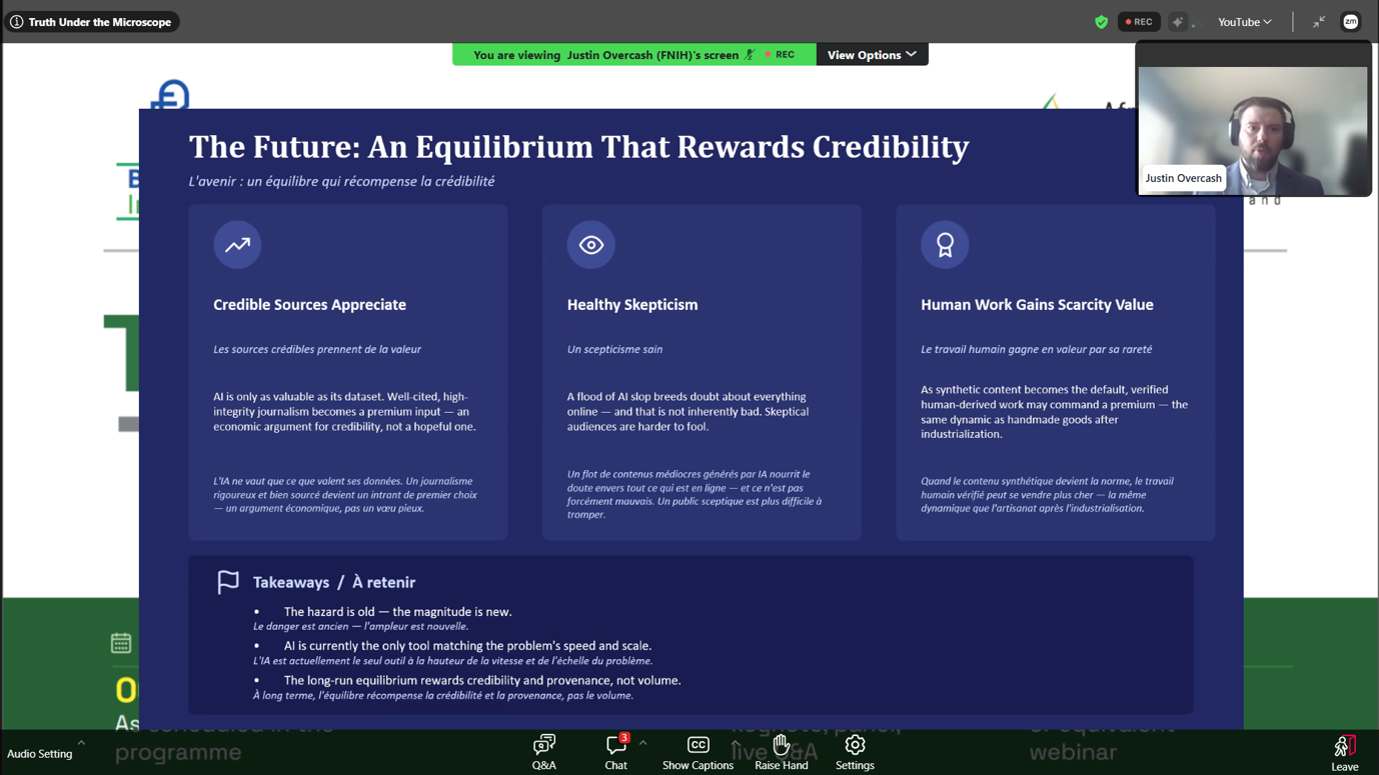
His presentation concluded with three key takeaways: the hazard of misinformation is old but its magnitude is new; AI is currently the only tool that matches the problem’s speed and scale; and in the long run, credibility and trustworthiness will become the most valuable assets in the information ecosystem.
Dr. Tara Kirk Sell, Senior Scholar at the Johns Hopkins Center for Health Security and Associate Professor at the Bloomberg School of Public Health, set off by highlighting the information threat landscape. In her presentation, she provided a structured framework for distinguishing between different types of harmful information making a distinction between key concepts: Misinformation, Disinformation and Malinformation.
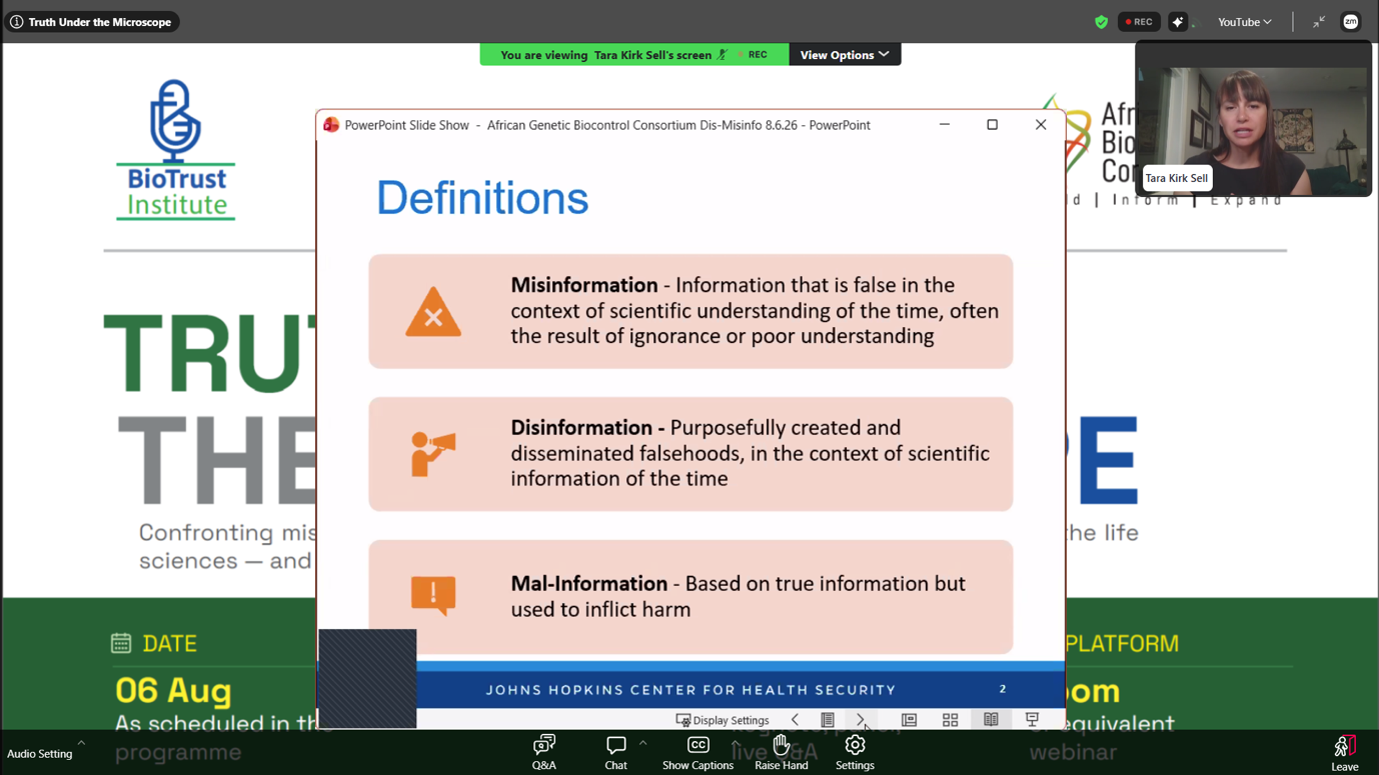
- Misinformation: False information shared out of ignorance or misunderstanding
- Disinformation: Deliberately created and disseminated falsehoods
- Mal-information: True information used with the intent to cause harm
She introduced the concept of the “infodemic”, describing it as the rapid, large-scale spread of both accurate and inaccurate health information across multiple channels. This overabundance of information, she explained, makes it increasingly difficult for the public to distinguish truth from falsehood. Drawing lessons from past crises such as the 2014 Ebola outbreak, she noted that misinformation often extends beyond the health crisis itself, frequently promoting discord, politicization, and increased risk behaviors.
To address these challenges, she presented the “4i Framework for Advancing Communication and Trust (4i FACT)”, which provides proactive strategies for combating misinformation and strengthening public confidence. She also referenced the Misinformation Playbook, a practical guide offering tools, templates, and examples for addressing health rumors, while cautioning that no single solution is perfect.
By combining definitions, case studies, and frameworks, Dr. Sell highlighted the urgent need for proactive communication strategies to counter harmful information and safeguard public trust in science and health systems.
Below:
Dr. Peter Babigumira Ahabwe makes his presentation during the webinar. He is an Epidemic Intelligence Analyst at the Uganda National Institute of Public Health and Director of Policy & Strategic Partnerships at Nuo Bioscience
Peter highlighted how misinformation takes root in life sciences: vaccine rumors that fuel hesitancy, persistent claims about GMOs interfering with DNA, biosecurity fears around gene drives and GM mosquitoes, and suspicions that clinical trial delays conceal wrongdoing. He reinforced these points with findings from a pre-webinar survey of participants, which revealed that most encounter life-science misinformation frequently, struggle to explain complex science to the public, and lack confidence in defining mis-, dis-, and malinformation.
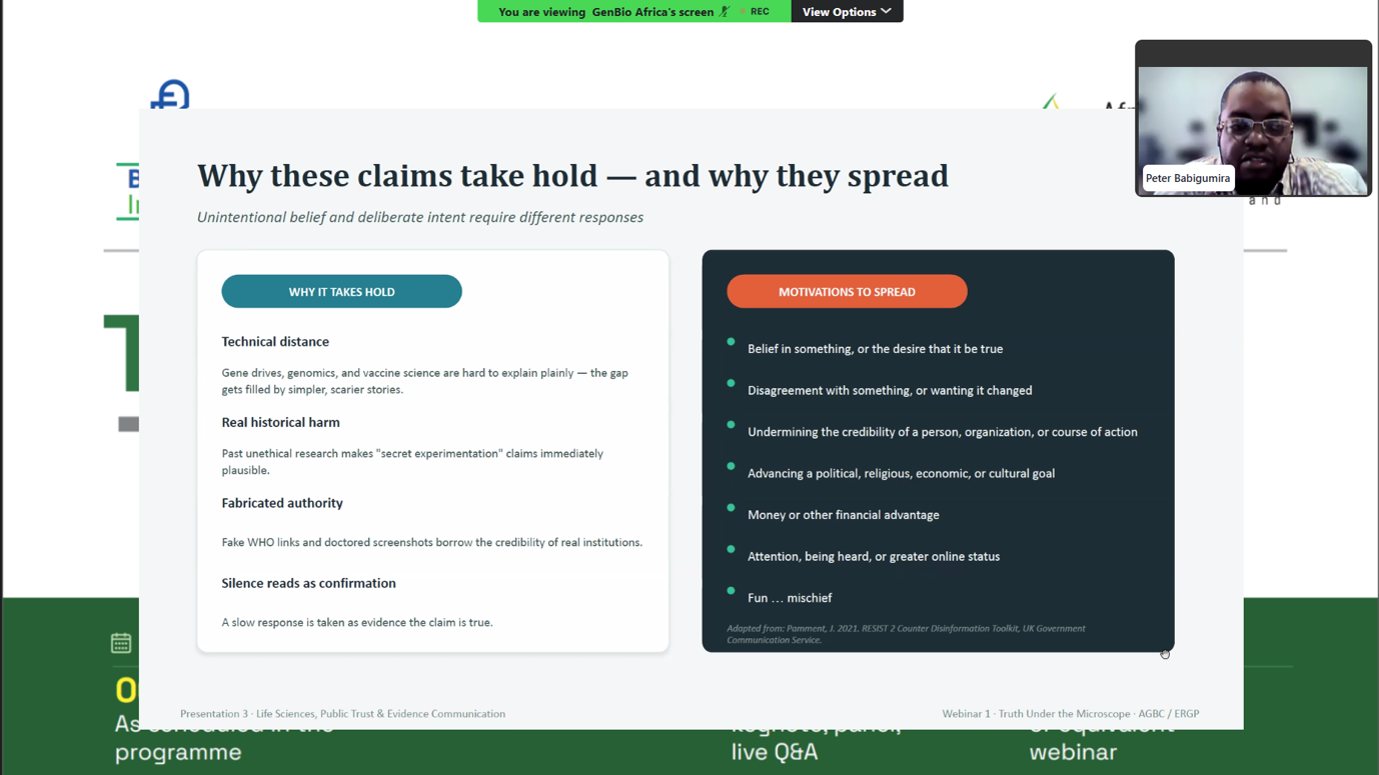
He explained why such claims spread so easily: the technical complexity of genomics and biotechnology, historical legacies of unethical research, fabricated authority through fake institutional links, and slow responses that appear to confirm rumors. Motivations range from genuine belief and disagreement to political, financial, or even mischievous intent.
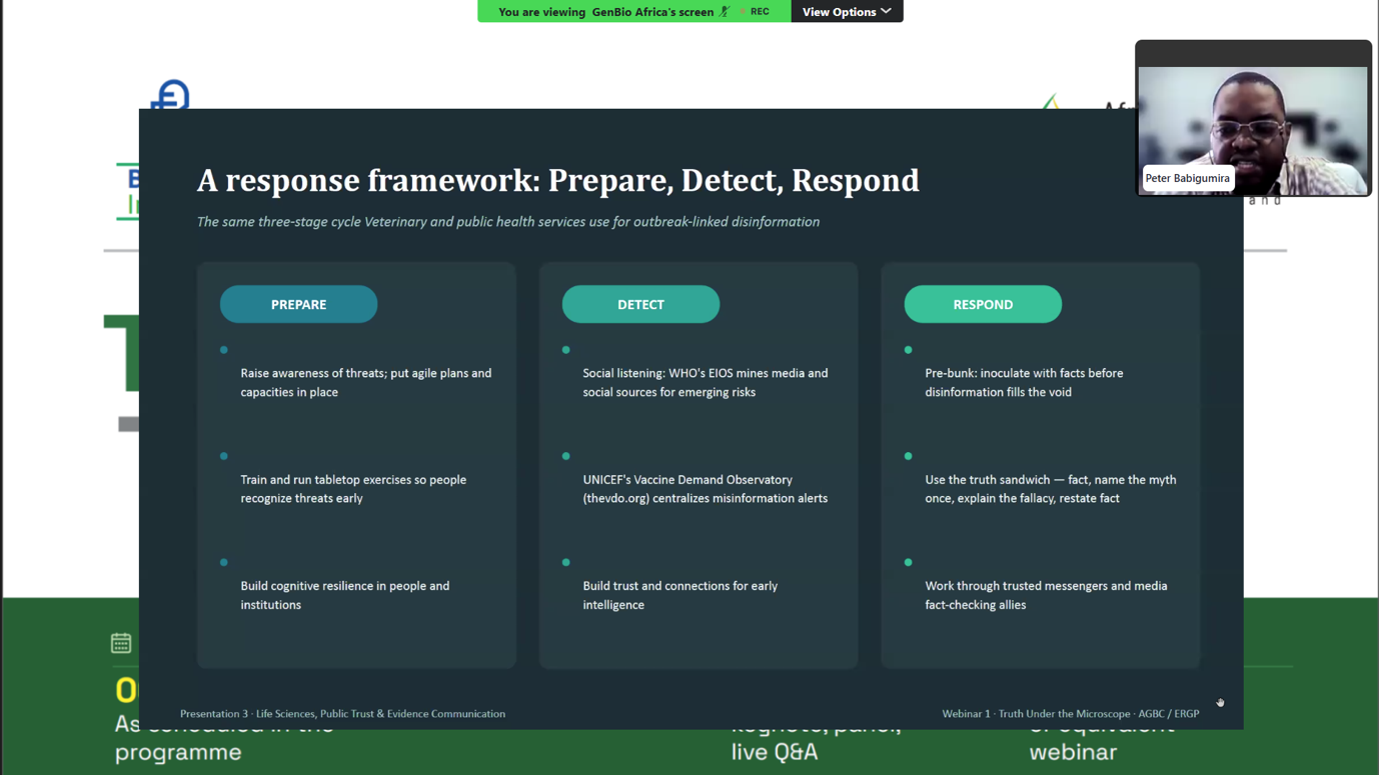
Dr. Babigumira proposed a simple response framework:” Prepare, Detect, Respond.
He underscored the need to diffuse elements that are intent on perpetrating misinformation by steering any conversation away from falsehoods to the direction of facts.
The webinar series hopes to enable distinction between misinformation, disinformation, malinformation and legitimate scientific uncertainty, and explanation of their implications for science communication and public understanding. It is also hoped that participants will be able to assess how emerging tools- can both amplify and mitigate the spread of false or misleading information
The interactive exercises reinforced that trust is built not by winning arguments but by preparing, detecting and responding with transparency and evidence before rumors take hold. Participants left with commitments to take concrete actions within their spheres of influence, underscoring the importance of accountability and collaboration.
Series two in the webinar will tackle “Trust by Design: Communicating Emerging Technologies with confidence.
Webinar 1: Link to recording
https://www.youtube.com/live/pzXUz27MY0U
Interested participants are welcome to register for webinar 2:
https://us06web.zoom.us/webinar/register/WN_inbxGHKDS_CxHRje4DeJHQ